
Snohomish County Directory Runs
The Washington State Library county-directory list is the best starting inventory for Snohomish County city directories. It shows substantial coverage, but not an unbroken annual series. It is also a shelf list, not a claim that each book can be read online. R. L. Polk & Co. published the confirmed 1902–03 Everett and Snohomish County volume, which includes Everett, Snohomish, Stanwood, Startup, and smaller communities.
| Collection | Years or scope | Where held | Access route |
|---|---|---|---|
| County directory run | 1882–1887; 1901–1920; 1922–1923; 1925–1933; 1935; 1937 | Washington State Library | Thursday appointment or librarian inquiry |
| Later county volumes | 1952–1982; 1984; 1992–1998; 2000–2005 | Washington State Library | Appointment or interlibrary-loan inquiry |
| Polk's Everett & Snohomish County Directory | 1902–03 confirmed | State Library and SIGS references | Library or research-library access |
| Everett directory transcription | 1900 | Sno-Isle Genealogical Society | Early Everett research project |
| Reverse and telephone books | Exact local run not confirmed | State Library, Sno-Isle catalog, Humble House | Ask staff to check shelf holdings |
The gaps matter. A missing year may reflect the collection rather than the absence of a household. Search the closest earlier and later volume, then ask staff whether an edition sits under a city name, county title, telephone-book heading, or Polk publisher entry. Do not assign dates to a local reverse-directory run without inspecting the catalog or book.
Reading Snohomish Polk Directories
The 1902–03 Polk title gives a firm point in the Snohomish County city directory timeline. The SIGS Early Everett resources also identify an enhanced transcription of the 1900 Everett directory, later published and indexed by Kelcema Books in 2005. These local finding aids are useful because historical names can appear under Everett, Snohomish City, or a smaller town heading instead of one countywide alphabet.
Preserve the printed form. Search initials, married-name conventions, and likely Scandinavian spelling variants, but record what the source actually says. Occupation and employer fields can separate two people with the same name. A Startup laborer, an Everett waterfront worker, and a Snohomish merchant may share initials while appearing in very different local sections.
Snohomish Directory Research Desks
Access is spread among several desks. Sno-Isle Libraries genealogy resources provide Ancestry Library Edition inside branches, HeritageHub and MyHeritage with a library card, and a growing historical-photo collection. The library's history and property research page points readers to staff help for genealogy, obituaries, and property work.
The Sno-Isle Genealogical Society library occupies Humble House at 19827 Poplar Way in Lynnwood. It is open Thursday and Saturday from 11 a.m. to 3 p.m., with Tuesday visits by appointment, and can be reached at 425-775-6267. Its county gazetteer, obituary index, yearbooks, cemetery work, early history, and directory transcriptions help fill holes that a general catalog leaves. At the state level, the Tumwater library closed to general walk-in use in 2025, so contact staff about limited Thursday appointments from 1 to 4 p.m. and possible lending help before traveling.
The State Library directory page shown below confirms the county runs and current access setting.
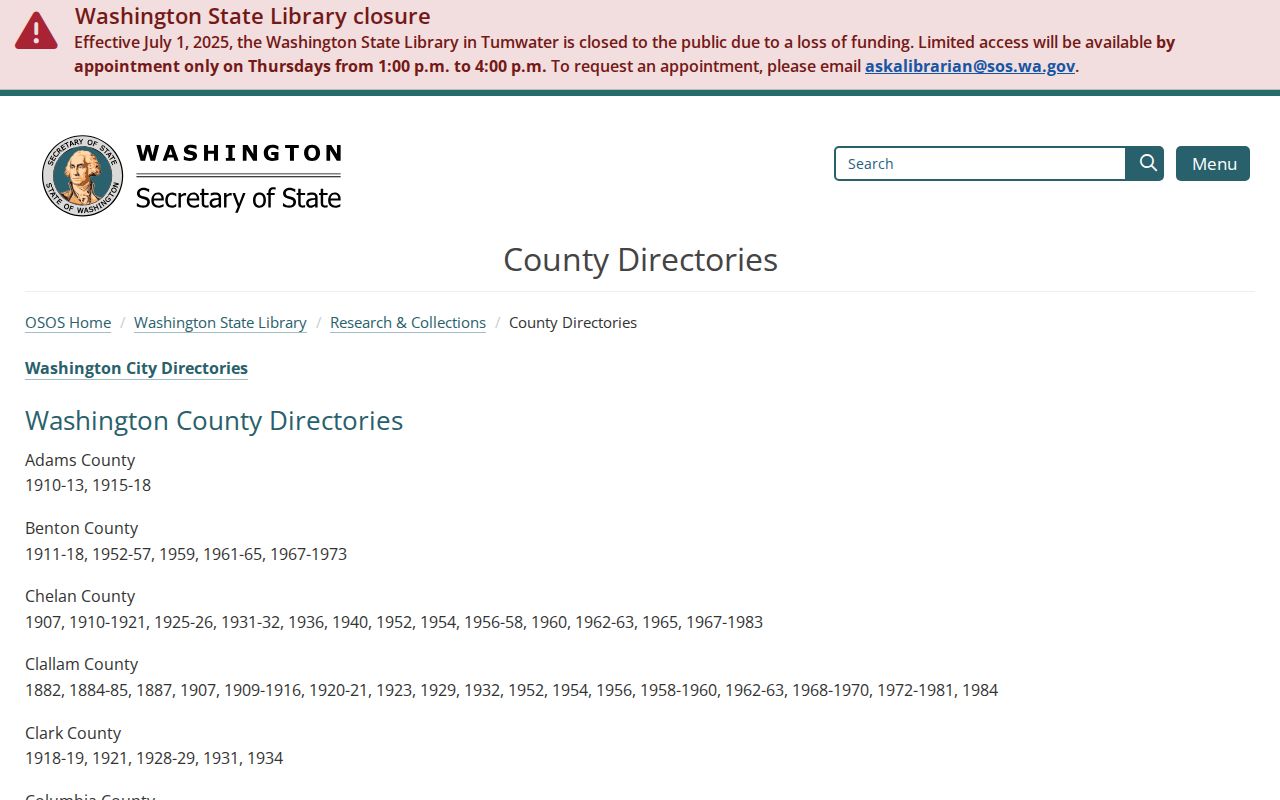
The image is an inventory doorway. It does not mean each listed edition has a public digital scan, so an appointment or staff request may still be needed.
Snohomish Genealogy Directory Tools
Library databases add context to a printed entry. The Sno-Isle genealogy page brings together obituary searches, historical records, and photo sources under one library system. Ancestry Library Edition must be used in a branch. HeritageHub reaches U.S. obituaries and death notices from 1704 to today with a library card, while the exact title and year still control what can be found.
The Sno-Isle genealogy portal pictured below shows the local access point for these companion sources.
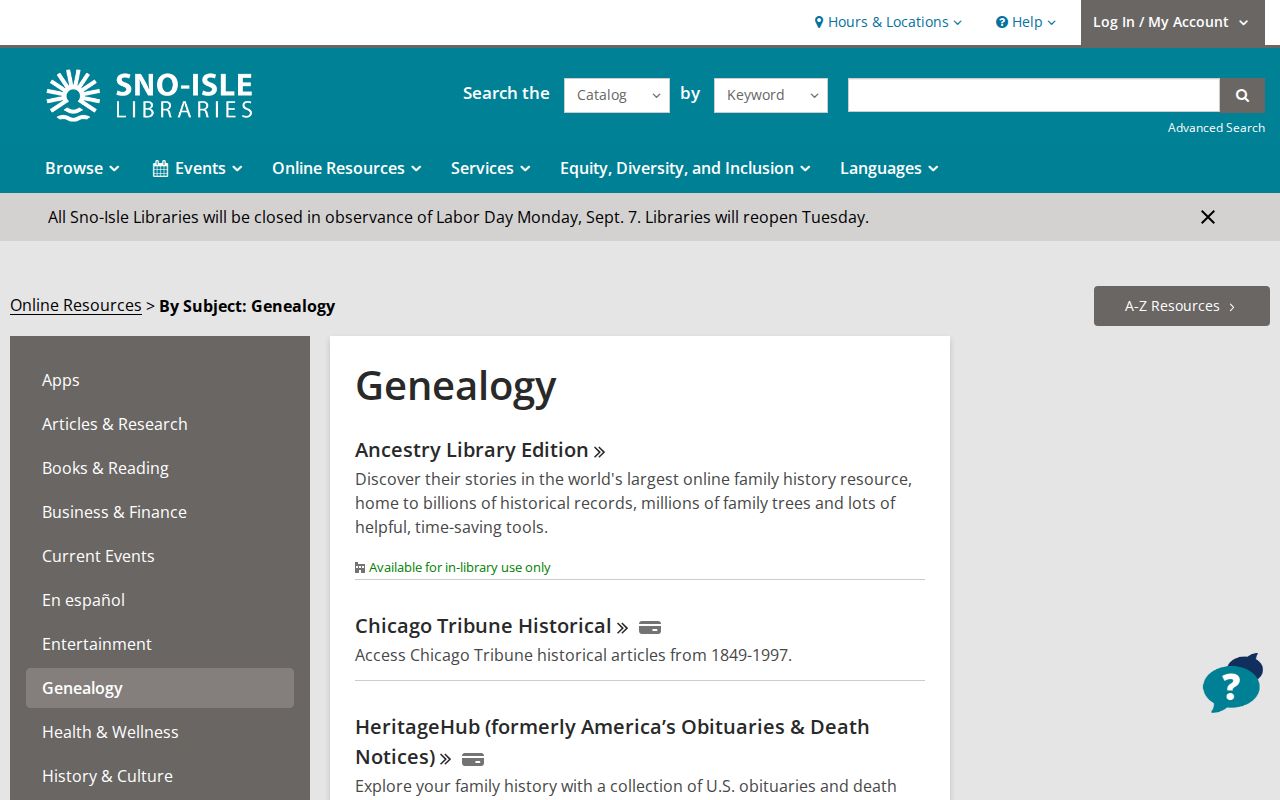
Use those databases after the directory has supplied a town, year, and spelling. That order keeps broad searches tied to a real Snohomish County record.
The library also gathers its research starting points on the Sno-Isle History and Current Events page.
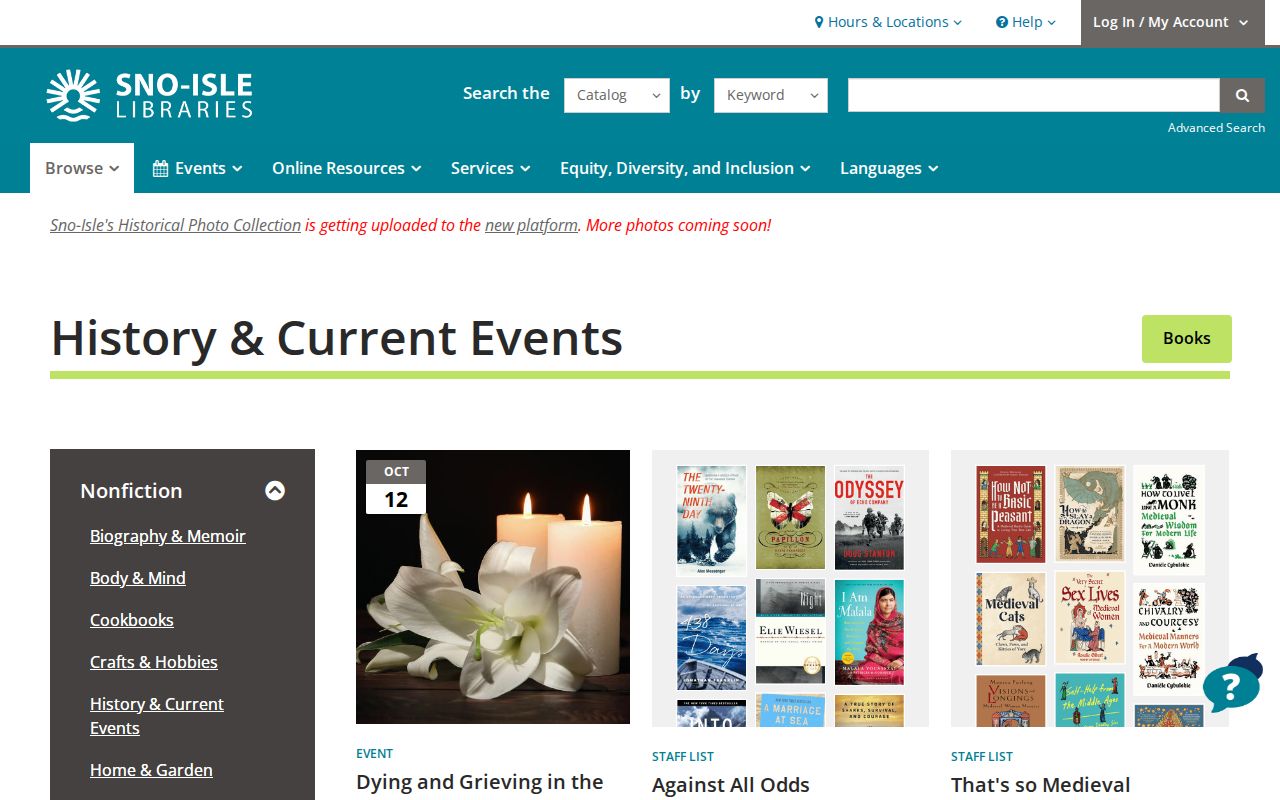
That page is the practical handoff from a printed name to obituary, property, newspaper, and local-history help from library staff.
Decode a Snohomish Directory Entry
An entry should be copied exactly before it is interpreted. The accessible official pages confirm titles and transcriptions, but do not expose a full scanned entry or abbreviation key. Therefore, treat the fields below as items to verify on the actual page, not as proof that every Snohomish County volume used every mark. Photograph or copy the edition's key first.
| Name | Surname, given name, initials, and sometimes a spouse or household note |
|---|---|
| Work | Occupation, trade, employer, or business address when printed |
| Address | House number and street, sometimes with residence or boarding shorthand |
| Tenure mark | A symbol may mark an owner or renter, but only the volume key can confirm it |
| Family clue | Spouse, widow, household, or telephone notation may distinguish namesakes |
- Criss-cross directory
- A directory arranged by street or telephone number instead of only by surname.
- Householder index
- A list keyed to the person treated as head of a household at an address.
- Abbreviation key
- The edition's own legend for short forms such as occupations, residence marks, and household status.
The entry establishes that a publisher linked a printed name with an address in that edition. It does not prove ownership or list all people in the home. Check an owner claim through county property and deed records, and treat a spouse or child who is not named as unknown rather than absent.
Snohomish Records Beyond Directories
The Washington State Archives Northwest Regional Branch at Western Washington University holds selected county, city, school, utility, and district series. It is open Wednesday through Friday by appointment; email and phone requests are available on other days. Transfers are selective and ongoing. A failed online search should lead to a catalog and custodian check, not a claim that the record never existed.
The Snohomish County Superior Court case-file collection shown below covers a broad 1950–2026 title range, with restrictions that vary by case type and year.
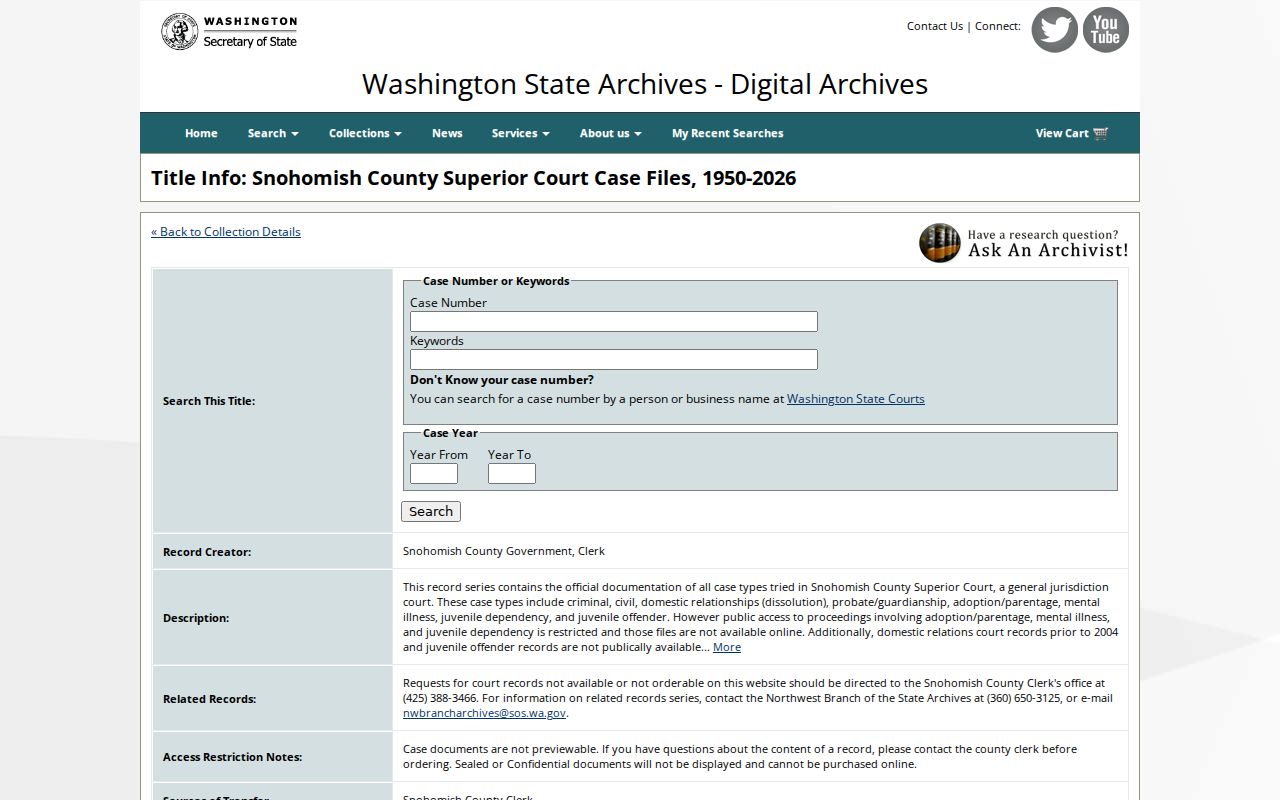
The archive image illustrates why a directory find often points outward to a court, school, or local-government series rather than ending the search.
Snohomish Names at Blackman House
The Snohomish Historical Society keeps an archive in the 1878 Blackman House, 118 Avenue B in Snohomish. Photos, oral histories, scrapbooks, family papers, and local-industry records can connect a printed directory name to a real building and community. The museum is generally open Sundays from noon to 3 p.m. from March through October; call 360-568-5235 before a focused research visit.
This is especially useful for a person tied to Snohomish City rather than Everett. Countywide titles can hide town-level detail. The broader county museum list also points to collections in Edmonds, Granite Falls, Lake Stevens, Marysville, Monroe, Mukilteo, Stanwood, and the Stillaguamish Valley.
Snohomish Directory Record Timeline
The county's books sit within a longer record history. Each date changes what a researcher should expect online, on a shelf, or at an archive.
| 1861 | Snohomish County was formed from Island County. |
|---|---|
| 1882–1887 | The earliest directory run listed by the State Library. |
| 1900 | The enhanced Everett directory transcription provides an early city name index. |
| 1902–03 | Polk's Everett and Snohomish County directory is confirmed. |
| 1909 | The earlier courthouse burned, making archive checks vital for some older records. |
| 2005 | The last year in the State Library's listed Snohomish directory run. |
The 1910 courthouse reused arches from its predecessor. That visible survival should not be confused with complete record survival. For pre-1910 court or deed links, ask whether a file was reconstructed, moved, microfilmed, or lost.
Trace Snohomish Families by Directory
A directory-to-census trail works best when each step preserves the town label and source year. Compact Everett and Snohomish street sections can cover households missed by a broad surname search. Farms and mountain routes may appear more clearly in census districts and deeds, especially around Darrington, Index, Startup, and the river corridors.
- Find the surname or address in an alphabetic section, then note the town or ward exactly.
- Copy spelling, initials, household notation, work, address, and all printed codes.
- Check the volumes on both sides of that year. A move or new widow note can appear between editions.
- Pair the closest city directory with the 1900 through 1950 federal census years. Federal census records open after 72 years.
- Test an ownership claim with assessor or deed records, then use an obituary or probate file to close the trail.
A disappearance has several meanings. The person may have moved, died, changed names, shifted to a rural route, or simply gone unlisted. SIGS obituary extracts cover Edmonds newspapers from 1905 to 1930 and Richmond Beach Herald material from 1924 to 1927, with wider local newspaper indexing. HeritageHub and the Everett Daily Herald can then extend the search. For a modern address check, move to the Snohomish County street directory rather than treating an old book as current.